
| Yes. Since June 2025, Google offers a Weather API as part of Google Maps Platform. It returns current conditions, hourly forecasts up to 240 hours, daily forecasts up to 10 days and the past 24 hours of history. It needs a Google Cloud API key with billing, includes a free monthly allowance, and is not available in a few countries. |
Table of Contents
Key Takeaways
- Google’s official Weather API is part of Google Maps Platform and reached general availability on 30 June 2025.
- It covers current conditions, forecasts up to 10 days, 24 hours of history and weather alerts, and is billed per request after a monthly free allowance.
- The unofficial iGoogle weather API that many old tutorials use stopped working in August 2012. Yahoo’s weather API was retired in January 2019.
- The US National Weather Service API is free, needs no key and returns public-domain data, but covers US locations only.
- If you need long-range history, plans that scale from free to high volume, or a simple REST API outside the Google Cloud setup, a dedicated weather API can be a better fit.
“Google weather API” is one of the most searched developer queries about weather, and for years the honest answer was “there isn’t one”. That changed in 2025. This post explains what Google offers now, what happened to the API old tutorials still reference, where Yahoo, Apple and The Weather Channel stand, and how to choose.
The short answer
Google launched the Weather API in Google Maps Platform, which became generally available on 30 June 2025. According to Google’s product page and documentation, it offers:
| Feature | What Google’s Weather API provides |
|---|---|
| Current conditions | Temperature, feels-like, humidity, wind, UV, visibility, cloud cover and more |
| Hourly forecast | Up to 240 hours ahead |
| Daily forecast | Up to 10 days |
| Hourly history | The past 24 hours (docs) |
| Weather alerts | Public alerts from official providers where available |
| Authentication | Google Cloud API key, passed as key |
| Units | Metric by default; unitsSystem=IMPERIAL for imperial |
| Coverage | Global, except China, Cuba, Iran and North Korea; Japan and South Korea get alerts only (coverage) |
| Pricing | Pay-as-you-go “Weather Usage” SKU with a monthly free allowance (billing) |
It is powered by Google’s MetNet weather models, which Google says improve its next-12-hour precipitation forecasts. A current-conditions request looks like this:
Request
GET https://weather.googleapis.com/v1/currentConditions:lookup?key=YOUR_API_KEY&location.latitude=37.4220&location.longitude=-122.0841So yes, a Google weather API exists, and it is a serious product. Whether it is the right one for your project depends on what you need, which the rest of this post covers.
What happened to the original Google Weather API
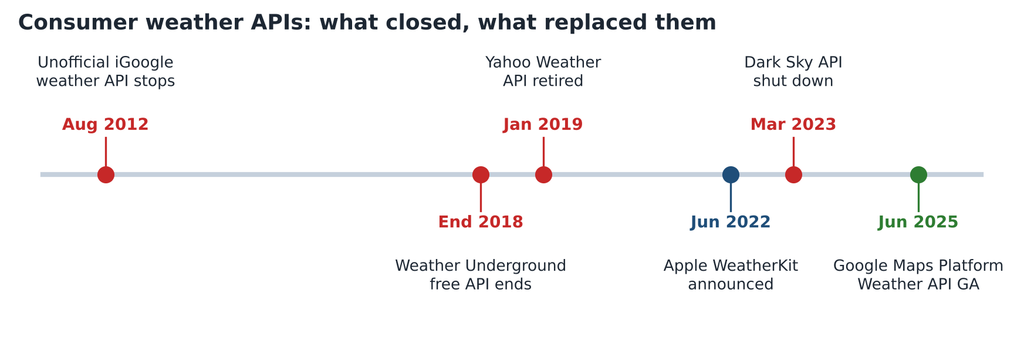
Before 2025, the “Google Weather API” people referred to was never an official product. It was an undocumented XML feed at google.com/ig/api that powered the weather gadget on iGoogle, Google’s personalized homepage. Developers discovered it and built apps on it. In late August 2012 it stopped responding, without an announcement, and the apps that depended on it broke. iGoogle itself shut down in November 2013.
If a tutorial or Stack Overflow answer tells you to call google.com/ig/api?weather=…, it is describing that feed, and it has not worked for over a decade.
Where the weather in Google Search comes from
Type “weather London” into Google and you get a full forecast card. That card is a Search feature, not an API. Its data comes from a mix of Google’s own forecasting models and partner providers, and it is built for people looking at a results page. There is no supported way to request it from code, and scraping it breaks Google’s terms.
If you want the data behind Google’s weather experiences in your app, the Maps Platform Weather API is the supported route.
Yahoo and The Weather Channel: same story
Yahoo Weather API
Yahoo’s public weather API, served from weather.yahooapis.com and through the YQL query service, was retired on 3 January 2019. Yahoo did not offer a public replacement, so projects that used it switched to other providers.
The Weather Channel and Weather Underground
The Weather Company, which owns The Weather Channel and Weather Underground, sells its data as an enterprise product with commercial licensing rather than a self-serve public API. Weather Underground’s popular free developer API ended in 2018, with access kept for members who contribute data from personal weather stations.
Apple WeatherKit
Apple’s WeatherKit, announced in June 2022 to replace the Dark Sky API (which shut down in March 2023), is available to Apple Developer Program members, with a REST API for non-Apple platforms. Membership includes up to 500,000 calls a month, with paid tiers above that.
The free government option: the National Weather Service API
For US locations, the National Weather Service API at api.weather.gov is free, needs no API key, and returns public-domain data you can use for any lawful purpose (NWS disclaimer). It is the most authoritative source for US forecasts, because it is the forecast the NWS itself issues.
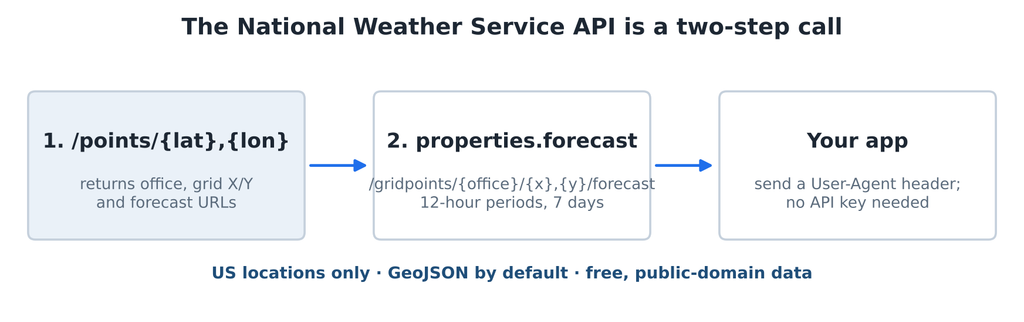
It works in two steps. First, look up the forecast grid for a coordinate:
Shell
curl -H "User-Agent: (myweatherapp.com, [email protected])" \
  https://api.weather.gov/points/38.8894,-77.0352
The response’s properties.forecast field holds a URL such as https://api.weather.gov/gridpoints/LWX/97,71/forecast. Request that URL, with the same header, for 12-hour forecast periods over the next seven days. properties.forecastHourly gives hourly periods.
| NWS API | Detail |
|---|---|
| Cost | Free |
| Key | None; a User-Agent header identifying your app is required |
| Coverage | US locations only |
| Forecast | 7 days, in 12-hour or hourly periods, on a grid of about 2.5 km |
| History | Recent station observations only; long-term records are in NOAA’s archives |
| Rate limits | Exist but are not published; retry after about 5 seconds if limited |
| Format | GeoJSON by default |
For historical records beyond what the NWS API keeps, see our guide to historical weather data, which covers NOAA’s archives in detail.
Commercial alternatives developers actually use
Google’s Weather API, the NWS API and dedicated weather APIs each fit different projects. Compare them on:
- Coverage: Global, or one country? Are any of your users in excluded regions?
- History depth: Google returns the past 24 hours. If you need last year, you need a provider with a historical archive.
- Forecast length: 7, 10 or 14 days?
- Account setup: Google requires a Google Cloud project with billing. Some teams want a standalone key.
- Pricing model: Per-request billing after a free allowance, or a fixed monthly plan with a quota.
- Commercial terms: Is commercial use allowed on the tier you plan to use?
Weatherstack, for example, offers current weather on all plans, historical data back to 2008 from the Standard plan, and forecasts up to 14 days on higher plans, with a free plan for testing. Our comparison of free weather APIs puts Weatherstack, OpenWeatherMap, Open-Meteo, the NWS, Visual Crossing and WeatherAPI.com side by side with every limit verified.
| Google Maps Platform Weather API | NWS API | Weatherstack | |
|---|---|---|---|
| Coverage | Global with exceptions | US only | Global |
| Key | Google Cloud API key with billing | None | Weatherstack API key |
| Forecast | Up to 10 days | 7 days | 7 or 14 days, depending on plan |
| History | Past 24 hours | Recent observations | Back to July 2008 (Standard plan and up) |
| Free usage | Monthly free allowance | Free | 100 calls a month |
Migrating: a minimal example
If you have code built around an old or unavailable weather API, the cleanest migration is a small function that returns your own plain object, so the rest of your app stops caring which provider sits behind it. This Node.js version calls Weatherstack’s current weather endpoint from the server, with the key in an environment variable:
JavaScript (weather.js), Node 20.6+
// weather.js: current weather from Weatherstack, normalized to one plain object.
// Run with: node --env-file=.env weather.js "Chicago"   (Node 20.6 or newer)
const API_KEY = process.env.WEATHERSTACK_KEY; // keep the key on the server

async function currentWeather(query, units = "m") {
  const url = new URL("https://api.weatherstack.com/current");
  url.search = new URLSearchParams({ access_key: API_KEY, query, units });

  const res = await fetch(url);
  const data = await res.json();
  if (data.error) throw new Error(`${data.error.code}: ${data.error.info}`);

  const { location, current } = data;
  return {
    place: `${location.name}, ${location.country}`,
    localTime: location.localtime,
    temperatureC: current.temperature,
    feelsLikeC: current.feelslike,
    condition: current.weather_descriptions[0],
    humidityPct: current.humidity,
    windKmh: current.wind_speed,
    windDirection: current.wind_dir,
    isDay: current.is_day === "yes",
  };
}

currentWeather(process.argv[2] || "New York")
  .then((weather) => console.log(weather))
  .catch((err) => {
    console.error(`Weather lookup failed: ${err.message}`);
    process.exit(1);
  });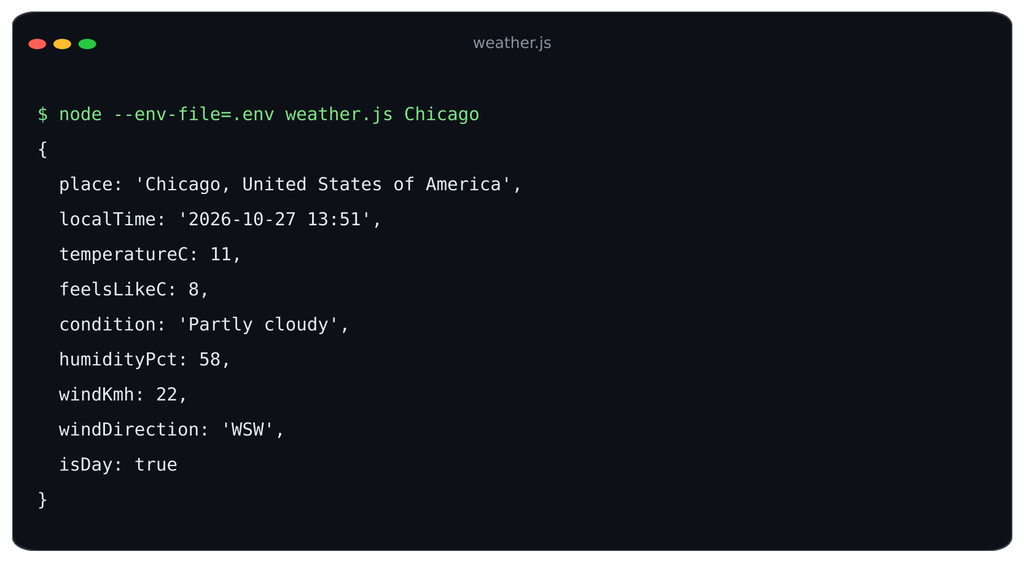
Output from a test run with sample data.
Because the function returns your own field names, switching providers later means changing one function, not every screen. The same pattern works for Google’s Weather API: map temperature.degrees to temperatureC, weatherCondition.description.text to condition, and so on.
FAQs
Is there a Google weather API?
Yes. Google Maps Platform has offered a Weather API since 2025, generally available from 30 June 2025. It provides current conditions, hourly and daily forecasts, 24 hours of history and alerts. The older iGoogle weather feed stopped working in 2012.
What does Google’s weather API cost?
It is billed per request under Google Maps Platform’s pay-as-you-go Weather Usage SKU, after a monthly free allowance. Check Google’s current price list for the per-1,000 rate, since Maps Platform pricing changes over time.
Is the National Weather Service API free?
Yes. The NWS API at api.weather.gov is free, needs no API key and returns public-domain data. It requires a User-Agent header and covers US locations only.
What replaced the Yahoo weather API?
Yahoo retired its weather API on 3 January 2019 without a public replacement. Developers moved to other providers, such as the NWS API for US data or commercial weather APIs like Weatherstack for global coverage.
| Try a standalone weather API in minutes. Get a free Weatherstack API key and run the example above against your own city. |