
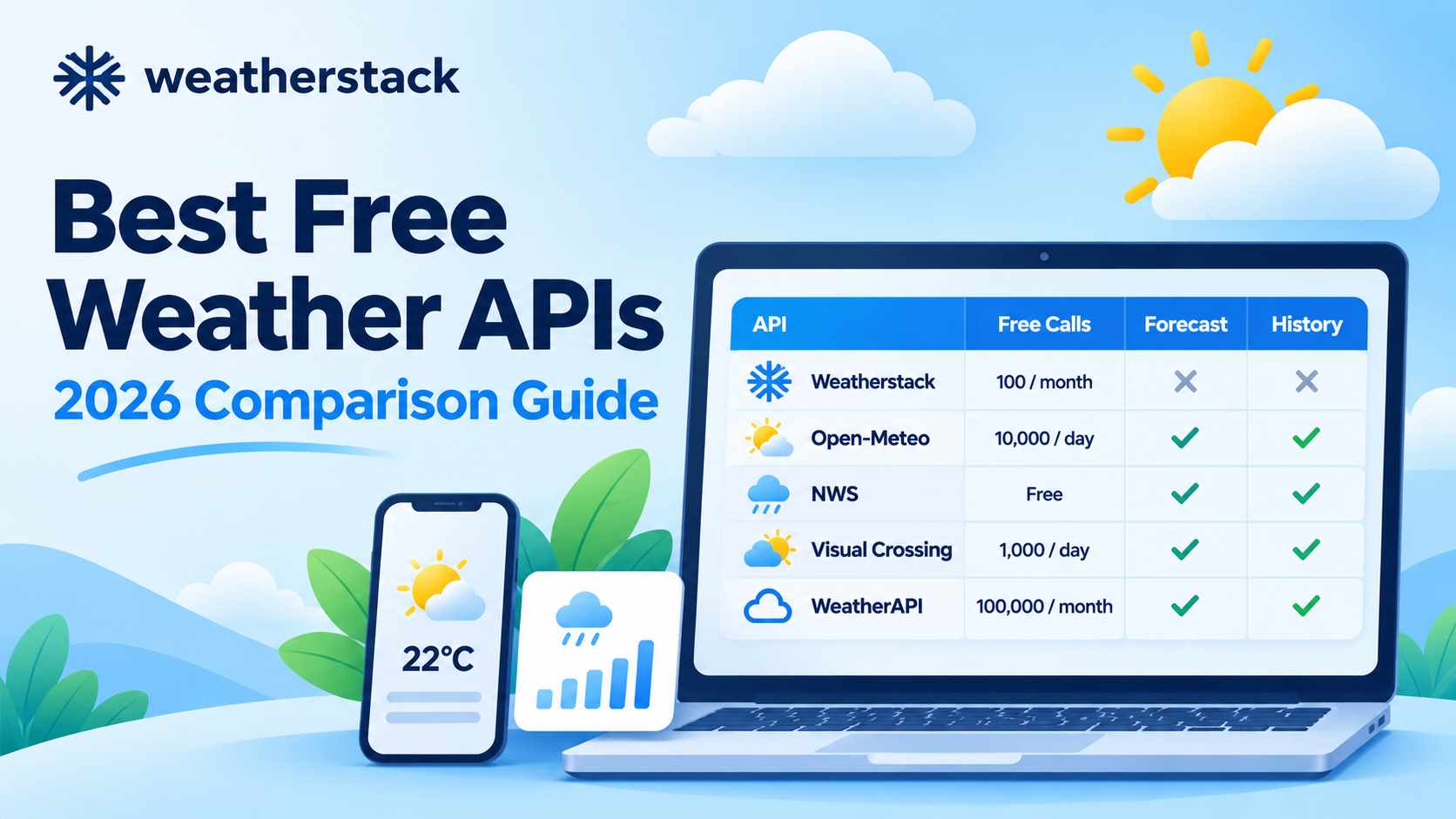
| The best free weather API depends on the project. Open-Meteo offers the most free calls and needs no key, but its free tier is non-commercial. WeatherAPI.com gives 100,000 calls a month with commercial use allowed. The US National Weather Service API is free and public domain but covers only the US. Weatherstack’s free plan suits learning; paid plans add forecasts and history. |
Table of Contents
Key Takeaways
- Free tiers differ more on terms than on data: check commercial-use rules before you check request limits.
- Open-Meteo and the National Weather Service need no API key. Open-Meteo’s free tier is non-commercial; NWS data is public domain but US-only.
- WeatherAPI.com (100,000 calls a month) and Visual Crossing (1,000 records a day) allow commercial use on their free plans.
- Weatherstack’s free plan gives 100 calls a month of current weather for non-commercial use. Paid plans start at 50,000 calls and add historical data, then forecasts.
- Free tiers are for building and testing. Anything with users should run on a plan with a predictable quota and terms that fit the business.
Every “best free weather API” list seems to come with a comparison table full of “not specified”. This one has none. Each cell below comes from the provider’s own pricing or documentation page, checked in October 2026, and each limitation is stated as plainly as each strength. We make Weatherstack, so it goes first, with its free tier described exactly as it is.
The comparison table
| API | Free requests | Forecast on free tier | Historical on free tier | Key required | Commercial use on free tier |
|---|---|---|---|---|---|
| Weatherstack | 100 calls / month | No (7 days from Professional plan, 14 from Business) | No (from Standard plan, back to July 2008) | Yes | No (paid plans allow it) |
| OpenWeatherMap One Call 3.0 | 1,000 calls / day, then billed per call | Yes: 48 h hourly, 8 days daily | Yes: back to 1979, within the same 1,000 calls | Yes (One Call subscription) | Yes |
| Open-Meteo | 10,000 calls / day | Yes | Yes: ERA5 reanalysis from 1940 | No | No (paid plans; data licensed CC BY 4.0) |
| NWS (api.weather.gov) | Free; rate limits not published | Yes: 7 days, US only | Recent station observations only; archives via NOAA NCEI | No (User-Agent header required) | Yes (public domain) |
| Visual Crossing | 1,000 records / day | Yes | Yes: 50+ years | Yes | Yes |
| WeatherAPI.com | 100,000 calls / month | Yes: 3 days | Yes: past 1 day | Yes | Yes (link back requested) |
Verified October 2026 against each provider’s pricing or documentation page (links in each section below). Free tiers change; check the provider’s page before you build on one.
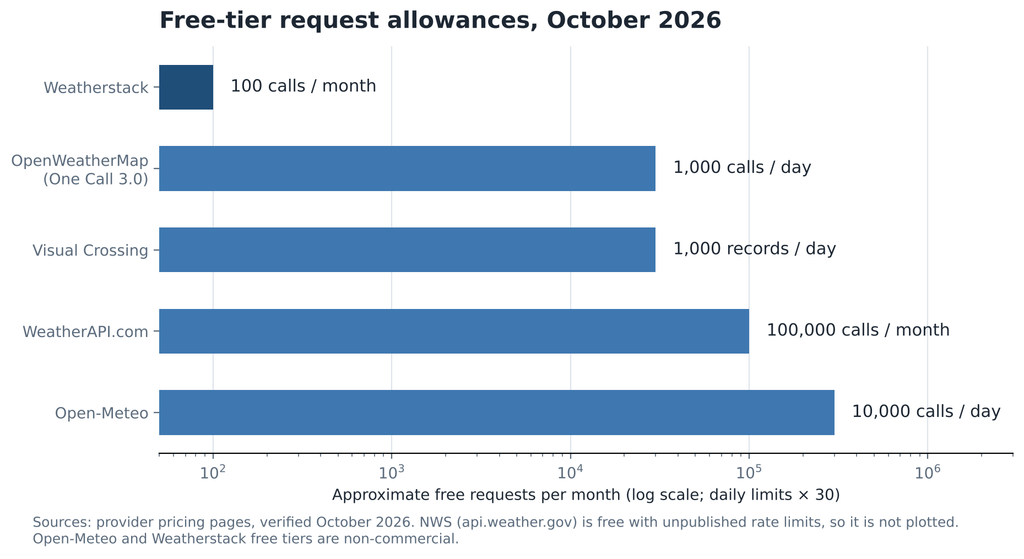
Free allowances on a log scale. Daily limits are multiplied by 30 for comparison.
Two notes on reading the table. First, “calls” and “records” are not the same unit: Visual Crossing counts records, so a 15-day forecast or a long historical range uses more than one. Second, a large free allowance with non-commercial terms is a different offer from a smaller allowance you can ship a product on.
Weatherstack
Free tier: 100 calls a month of real-time weather, HTTPS included, for non-commercial use (pricing).
Paid tiers: Standard ($9.99 a month, 50,000 calls) adds historical data back to July 2008 and commercial use. Professional ($49.99, 300,000 calls) adds a 7-day forecast. Business ($99.99, 1,000,000 calls) extends forecasts to 14 days.
Strengths: One simple REST API for current, historical and forecast data. Locations can be a city, a US zip code, a UK or Canadian postcode, coordinates or an IP address. Responses are compact JSON with metric, imperial and scientific units selectable per request. It is a good fit for tutorials: our JavaScript weather app tutorial runs entirely on the free plan.
Limits: 100 calls a month is the smallest free allowance in this table. It is enough to build and demo a project, not to run one. Forecasts are not on the free or Standard plans.
Pick it if you want one provider from prototype to production and are happy to move to a paid plan when the app goes live. See the product overview.
The others
OpenWeatherMap (One Call API 3.0)
OpenWeatherMap’s One Call API 3.0 bundles current conditions, a 1-minute precipitation forecast for the next hour, 48 hours of hourly forecast, 8 days of daily forecast, government alerts and historical data back to 1979 into one endpoint. The first 1,000 calls a day are free and the rest are billed per call, so it needs the separate One Call subscription. The combination of forecast, minute-level rain and deep history on a free tier is hard to beat. Watch your usage, though: a busy day becomes a bill rather than an error, so set a daily call cap in your account. Pick it if you want forecasts and history without paying up front and can manage per-call billing.
Open-Meteo
Open-Meteo is open source, needs no key, no sign-up and no card, and allows up to 10,000 calls a day for non-commercial use. Its historical API is built on the ERA5 reanalysis, hourly from January 1940. Forecast data comes from national weather services’ models. The catch is in the terms: commercial use needs a subscription, and the data is licensed CC BY 4.0, so you must credit it. Pick it if you are prototyping, studying or running research and want large volume with zero setup. It is also the strongest choice in this list if you want to self-host, since the code is open source.
National Weather Service (api.weather.gov)
The NWS API is free, needs no key (only a User-Agent header that identifies your app) and returns public-domain data that you may use for any lawful purpose (NWS disclaimer). Forecasts come from the NWS forecast offices on a grid of about 2.5 km, out to 7 days. The limits: US locations only, unpublished rate limits, and a two-step request pattern (look up the grid point first, then fetch its forecast). The API keeps only recent observations; long-term history lives in NOAA’s archives. Pick it if your users are in the US and you want authoritative government forecasts at no cost.
Visual Crossing
Visual Crossing’s free plan allows up to 1,000 records a day, includes more than 50 years of historical data, and can be used by businesses. It is built for analysts as much as developers: one Timeline API returns history and forecast in the same call, and you can download CSV directly from its query builder. Because billing is per record, long date ranges use the allowance quickly: a year of daily history is 365 records. Pick it if historical analysis is the main job, especially for spreadsheets and BI tools.
WeatherAPI.com
WeatherAPI.com has the largest keyed free allowance here at 100,000 calls a month, with commercial use allowed and no card needed. The free plan includes a 3-day forecast and the past day of history; longer ranges need a paid plan. Free users are asked to link back to the service. Pick it if you need a lot of current-weather calls for a commercial project and a 3-day forecast is enough.
Free API gotchas nobody mentions
- Non-commercial means non-commercial. A side project that adds ads or a subscription is commercial. Open-Meteo and Weatherstack’s free tiers do not cover it.
- Overage is not always an error. Pay-per-call tiers such as OpenWeatherMap’s keep answering past the free amount and bill you. Set caps in the dashboard.
- Attribution clauses. Open-Meteo’s CC BY 4.0 licence requires credit. WeatherAPI.com asks free users to link back. Build the credit line into your UI from day one.
- Keyless is convenient, not private. No key means anyone can call it, and providers rate-limit by IP. A shared office or cloud IP can hit limits you never caused.
- Units are a per-request setting. Compare like with like: one API’s default may be °C and km/h, another’s Kelvin and m/s.
- Your key still belongs on a server. A free key in browser code is a free key for everyone who views the source.
Which API for which project
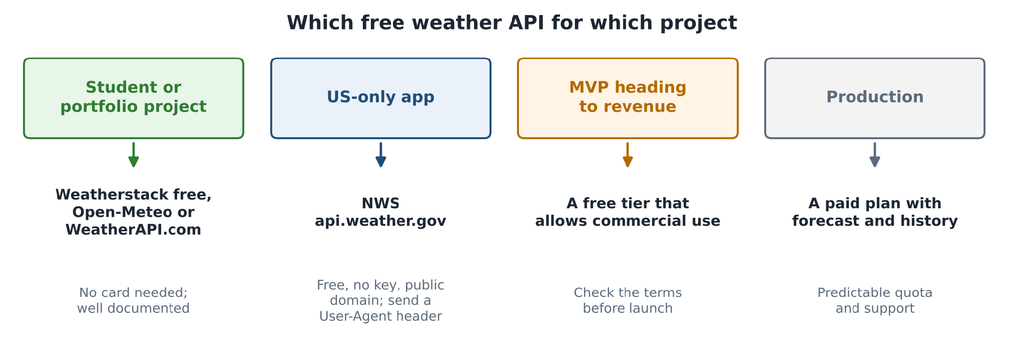
A quick way to narrow the list.
- Student or portfolio project: Weatherstack’s free plan, Open-Meteo or WeatherAPI.com. All are well documented and need no card.
- US-only app: The NWS API. Free, authoritative and public domain.
- MVP that will charge money: A free tier that allows commercial use (WeatherAPI.com, Visual Crossing, OpenWeatherMap), or a low-cost paid plan.
- Production with history or long forecasts: A paid plan. Compare quota, forecast length, historical depth and HTTPS, not just price.
If you came here looking for a weather API from Google, it now exists as part of Google Maps Platform. Our post on the Google Weather API covers what it offers and how it compares.
FAQs
What is the best free weather API?
It depends on the project. Open-Meteo offers the largest free volume with no key but is non-commercial. WeatherAPI.com allows commercial use with 100,000 free calls a month. The NWS API is free and public domain for US locations. Weatherstack’s free plan suits learning and prototypes.
Which weather API needs no key?
Open-Meteo and the US National Weather Service API (api.weather.gov) both work without a key. NWS asks you to send a User-Agent header that identifies your application.
Can I use a free weather API commercially?
Some, yes. WeatherAPI.com, Visual Crossing, OpenWeatherMap and the NWS API allow commercial use on their free tiers. Open-Meteo’s and Weatherstack’s free tiers are non-commercial; their paid plans allow it.
How many requests do free weather APIs allow?
As of October 2026: Open-Meteo 10,000 calls a day, WeatherAPI.com 100,000 a month, OpenWeatherMap One Call 1,000 a day, Visual Crossing 1,000 records a day, and Weatherstack 100 calls a month. NWS does not publish a limit.
| Start building today. Get a free Weatherstack API key (100 calls a month), then compare paid plans when you need history, forecasts and commercial use. |
Start Building with Weather Data
Start building today with a free Weatherstack API key and get 100 API calls per month. When you need historical weather data, forecasts, or commercial access, explore the available paid plans.